#4 – 20133 102nd Avenue, Langley, B.C. V1M 4B4 Canada

#4 – 20133 102nd Avenue, Langley, B.C. V1M 4B4 Canada
Injection molding is often described as a low-cost manufacturing method, but that claim needs context. In practice, its value appears when companies produce hundreds, thousands, or millions of identical parts. A heated polymer enters a carefully machined mold under controlled pressure. Seconds later, the part cools and moves toward assembly. This repeatable cycle reduces labor, limits variation, and supports predictable production planning. It also allows complex features, such as clips, ribs, bosses, and textured surfaces, to form in one operation.
The mold is the major investment. A precision steel tool may require detailed design, machining, testing, and maintenance before production becomes economical. Once completed, however, the same tool can produce many parts with limited additional cost per unit. Automated material feeding and robotic removal can reduce handling time further. Scrap may also decrease when engineers optimize runners, wall thickness, and process settings. Yet injection molding is not cheap by default. Small orders, frequent design changes, or poorly selected materials can weaken its financial advantage. Energy consumption and mold repairs deserve attention too. That part is sometimes overlooked.
From a manufacturing perspective, the strongest savings come from scale, repeatability, and design discipline. An experienced team reviews draft angles, cooling channels, tolerances, and expected production volume before cutting metal. Minor design changes can prevent major tooling problems later. Still, estimates remain imperfect. Real costs depend on geometry, resin prices, cycle time, quality requirements, and regional labor rates. Understanding these variables explains why injection molding can be remarkably cost effective, while showing when another process may be the wiser choice.
Why Is Injection Molding So Cost Effective?
Injection molding becomes increasingly economical when its tooling cost is spread across more than 100,000 parts. A production mold may require a large initial investment, including design, machining, testing, and adjustments. Suppose the mold costs $40,000. Divided across 100,000 parts, tooling contributes only $0.40 to each unit. At 500,000 parts, that contribution falls to $0.08.
The math is simple. However, real production costs include resin, labor, machine time, inspection, packaging, and maintenance. A well-designed mold can produce hundreds of identical parts during each shift. Automated ejection reduces handling, while stable cycle settings help control dimensions and surface quality. In practical production reviews, repeatability often becomes more valuable than a low starting quote. Fewer rejected parts mean less wasted material and fewer delayed shipments.
High volume changes the whole calculation. The first samples may reveal weak corners, uneven cooling, or difficult ejection. Fixing these issues can increase the tooling budget. That is the part people sometimes underestimate. Still, correcting a mold early is usually cheaper than repeating defects across 100,000 parts. The result is not automatically inexpensive. Poor design can spread waste just as efficiently. Careful part design, realistic tolerances, and documented inspections make the investment more reliable. Even then, forecasts can be wrong. Demand may slow, or the product may change before the mold reaches its expected volume.
Injection molding has a high upfront tooling cost, but that fixed cost is distributed across every part produced. This cost model assumes a $30,000 mold, a $0.50 production cost per part, and excludes material, packaging, and logistics costs.
At 100,000 parts, the tooling allocation falls to $0.30 per part, making the estimated total cost $0.80 per part. At 1,000,000 parts, the tooling allocation is only $0.03 per part, reducing the estimated total to $0.53 per part.
Injection molding becomes highly cost effective when one mold produces thousands of identical parts. Many production cycles finish within 15 to 60 seconds. Each cycle includes clamping, injection, cooling, and ejection. Once the process stabilizes, labor involvement can remain limited. An operator may monitor several machines instead of handling every part. This reduces the cost per unit as production volume increases.
The cycle time depends on material, wall thickness, mold design, and cooling performance. A thin housing may cool quickly, while a thicker connector needs more time. I have seen small changes in cooling channels reduce several seconds from a cycle. That sounds minor. Across 100,000 parts, it becomes significant. Automated part removal and in-line inspection can also reduce handling errors. However, speed alone does not guarantee savings. A rushed cycle may create warping, short shots, or visible sink marks.
Tooling costs can appear high at the beginning, especially for complex molds. Yet that cost spreads across every part made during the mold’s service life. Consistent dimensions also support reliable assembly and fewer rejected components. Process records, sample checks, and scheduled mold maintenance help protect that consistency. Still, real production is rarely perfect. Material batches vary, cooling may become uneven, and operators sometimes adjust settings too quickly. Careful validation matters more than impressive cycle-time claims.
Why Is Injection Molding So Cost Effective?
Why Near-Net-Shape Molding Can Keep Material Scrap Below 5%
Near-net-shape molding forms a component close to its final dimensions. Less machining follows. In controlled production trials, material scrap can remain below 5%. The exact result depends on part geometry, resin behavior, tooling quality, and process control.
A well-designed mold directs molten material through short, balanced flow paths. Gates and runners should match the part’s volume. Cooling channels also matter. Uneven cooling can create warpage, forcing rejected parts into the scrap bin. When engineers reduce unnecessary thickness and trim excess material, each shot produces more usable parts.
The savings are visible on the factory floor. A 100-gram shot may yield several finished components, with only a small runner system left behind. That leftover material can sometimes be reground, when specifications permit. However, recycled content may change flow, strength, or surface appearance.
This is where practical experience matters. I have seen scrap rise after a minor mold adjustment. A narrow gate caused incomplete filling, while excessive pressure produced flash. The original estimate looked excellent. Production reality disagreed.
Below 5% is a target, not a promise. Reliable results require measured scrap reports, stable material drying, regular mold inspection, and trained operators. Even then, early trial data may be incomplete. A careful manufacturer should review the numbers repeatedly before treating them as a dependable cost advantage.
Why Is Injection Molding So Cost Effective?
How Automation Reduces Labor, Defects, and Part-to-Part Variation
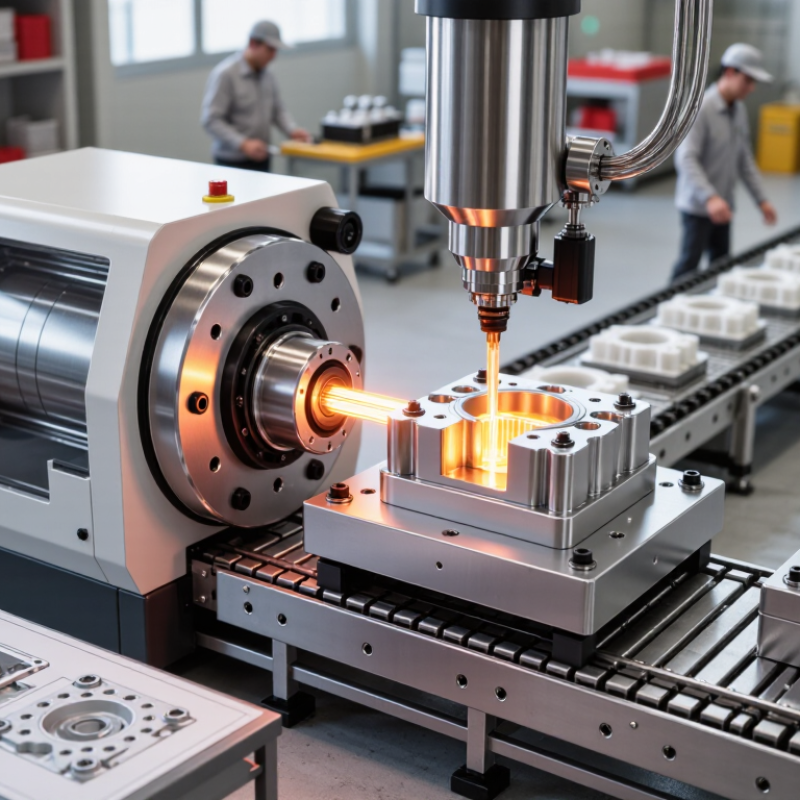
In a well-tuned molding cell, automation handles repetitive movements with steady timing. A robot removes each part, trims the gate, and places it on a cooling fixture. Operators spend less time reaching into machines or sorting warm components. They can focus on setup checks, material control, and process records. This reduces labor pressure without removing human judgment. Less rework also protects the production budget.
Automation improves consistency at several points. Sensors monitor mold position, temperature, pressure, and cycle time. A vision system can detect short shots, flash, or misplaced inserts within seconds. Defective parts leave the line before reaching a packing station. That matters when a small dimensional shift affects assembly. Stable handling also limits scratches, deformation, and uneven cooling between parts.
Automation is not magic.
A robot cannot correct poor mold design or incorrect drying conditions. Sensor drift can create false confidence if technicians skip calibration. Human review remains essential, especially after a material change or tool adjustment. In practice, the best results come from combining programmed control with experienced observation. A technician may notice a faint surface mark before software recognizes a pattern. That practical feedback should update the process, not disappear into a spreadsheet.
| Cost and Performance Dimension | Low-Automation Process | Automated Process | Change | Cost-Reduction Mechanism |
|---|---|---|---|---|
| Direct labor per 1,000 parts | 16.0 labor-hours | 4.0 labor-hours | −75% | Robots and conveyors handle part removal, transfer, and basic handling with less manual intervention. |
| Cycle time per shot | 30 seconds | 24 seconds | −20% | Consistent part removal and machine sequencing reduce handling delays between molding cycles. |
| Good parts per eight-hour shift | 3,456 parts | 4,320 parts | +25% | More sellable output is produced from the same machine and shift length. |
| Defect and rework rate | 3.0% | 1.0% | −67% | Repeatable motion and in-line checks help prevent missed parts, handling damage, and inconsistent inspection decisions. |
| Part-to-part dimensional variation | ±0.20 mm | ±0.08 mm | −60% | Stable positioning and repeatable process timing reduce variation caused by manual placement and handling. |
| Material scrap rate | 5.0% | 2.0% | −60% | Fewer rejected parts and more consistent process control reduce wasted resin, packaging, and processing time. |
| Labor cost at $20 per labor-hour | $0.32 per part | $0.08 per part | −75% | The same workforce can supervise more machines or be reassigned to higher-value setup, maintenance, and quality tasks. |
| Output consistency across shifts | Moderate variation | High repeatability | Improved | Programmed sequences deliver consistent timing, placement, inspection, and data collection across operators and shifts. |
Injection molding becomes cost effective when each cycle produces nearly identical parts. A repeatability of ±0.1 mm can reduce dimensional variation across thousands of shots. That consistency limits trimming, rework, and rejected assemblies. It also makes inspection faster. Less sorting means fewer labor hours beside the production line.
The ISO Survey 2023 recorded 1,265,216 ISO 9001 certificates worldwide. This figure reflects the importance of controlled, repeatable processes across manufacturing. ASQ quality-cost guidance often estimates poor quality at 15–20% of sales. That estimate is not universal. Still, it shows why small dimensional errors can become expensive. A 0.1 mm shift may appear harmless. In a tight-fitting housing, it can cause leaks, uneven gaps, or assembly delays.
Repeatability is not the same as accuracy. A mold can repeat the wrong dimension perfectly. Engineers must control cooling time, resin moisture, mold temperature, and clamping conditions. Measurement systems also need calibration. NIST measurement guidance emphasizes traceability and uncertainty, because every tolerance decision depends on reliable data. That part is sometimes overlooked.
A practical example is a connector housing. Stable dimensions can reduce manual fitting and prevent repeated tool adjustments. However, ±0.1 mm should not become a blanket promise. Geometry, material shrinkage, and part size change the result. Good process data matters more than a perfect headline number.