#4 – 20133 102nd Avenue, Langley, B.C. V1M 4B4 Canada

#4 – 20133 102nd Avenue, Langley, B.C. V1M 4B4 Canada
Choosing reliable Circuit Breaker Parts suppliers in 2026 requires more than comparing prices. Electrical distributors, panel builders, and maintenance teams need parts that perform consistently under heat, vibration, moisture, and repeated switching. A cracked insulating barrier or poorly fitted contact can delay production and compromise equipment safety. This guide examines leading suppliers through practical criteria, including product quality, technical documentation, testing procedures, delivery performance, and after-sales support.
Evidence matters more than polished promises. Reputable suppliers should provide clear specifications, material information, compatibility guidance, and traceable quality records. Their catalogs should identify terminals, trip units, operating mechanisms, arc chutes, auxiliary contacts, and replacement accessories accurately. Experienced buyers also check dimensions before ordering. A component that looks identical may use different mounting holes or connection ratings. Small details matter.
No supplier is perfect. That matters.
Market rankings can change as factories relocate, certifications expire, or product lines are redesigned. Therefore, this overview avoids treating brand reputation as permanent proof. It encourages readers to compare current documentation, sample quality, warranty terms, response times, and independent customer experiences. Technical specialists should confirm every part against the breaker model, electrical rating, installation environment, and applicable requirements. A low-cost purchase may become expensive after rework, downtime, or repeated failures. The strongest suppliers combine dependable manufacturing with honest communication, practical engineering support, and consistent availability. Even so, buyers should verify every claim before making a critical procurement decision.
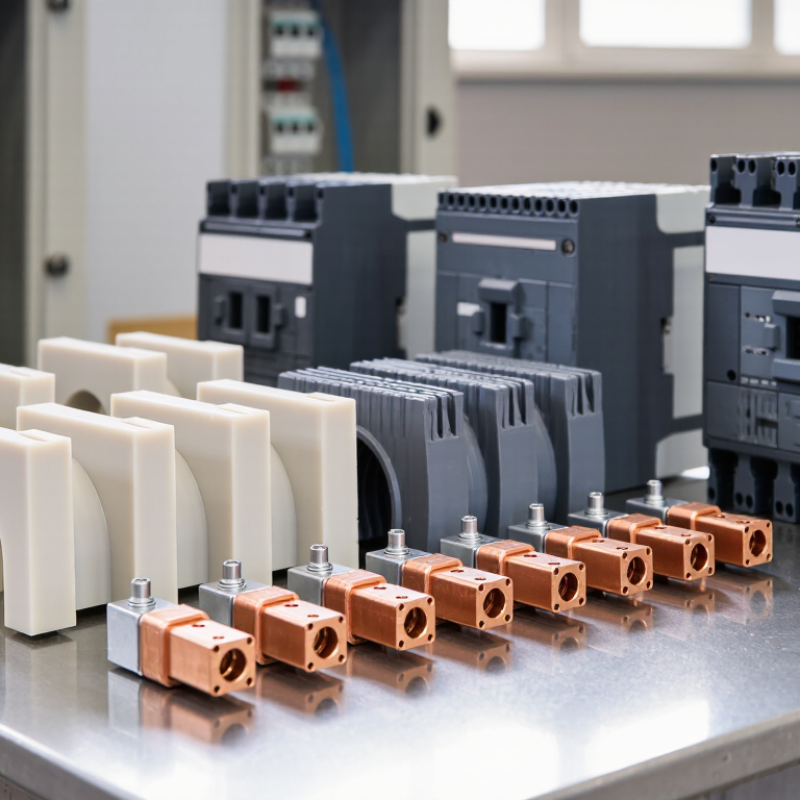
Circuit breaker parts are the small controls behind dependable electrical protection. Common components include contacts, arc chutes, trip units, springs, terminals, operating handles, and molded enclosures. Each part has a specific duty. Contacts carry current, while the trip unit detects overloads or short circuits. The arc chute cools and separates the electrical arc after interruption. A weak spring can delay opening. That detail is easy to miss.
The IEA Electricity 2024 report forecasts global electricity demand to grow by about 3.4% annually through 2026. More demand increases pressure on distribution equipment and replacement parts. When evaluating suppliers, maintenance teams should check interrupting ratings, voltage class, temperature limits, material traceability, and test documentation. IEC 60947-2 and applicable national standards provide useful reference points for low-voltage circuit breakers. However, a compliant part may still fail when its dimensions, connection method, or trip curve do not match the installed breaker. Compatibility deserves more attention than price.
Tips: Photograph the original part before ordering. Record the catalog code, frame size, terminal position, and fault rating. Ask for test certificates and production dates. Do not mix a high-capacity trip unit with an unsuitable enclosure. Field experience shows that “almost identical” parts create avoidable problems. I would also recheck old drawings; some contain revisions that technicians never received. Supplier reliability means more than inventory. It includes clear specifications, responsive technical support, stable quality control, and honest limits.
2026 Top Circuit Breaker Parts Suppliers?
When evaluating circuit breaker parts suppliers in 2026, verify more than price and delivery promises. Check their experience with contacts, arc chutes, trip units, springs, terminals, and insulating components. Ask for production records, material certificates, and test results for each critical part.
Reliability should be measurable. Confirm traceability from raw material batches to final inspection. Review quality controls, failure analysis procedures, and compliance with applicable IEC or UL requirements. A capable supplier should explain short-circuit testing, temperature-rise testing, and dimensional tolerances clearly. Technical support also matters. Engineers should help verify fit, interrupting performance, and compatibility with existing equipment. Vague answers deserve attention. A perfect supplier rarely exists, so document weaknesses and judge their response.
Tips: Request samples before approval. Test parts under realistic load conditions. Compare actual lead times with quoted schedules. Visit the facility when possible, and inspect storage areas for moisture, dust, and damaged packaging. Ask how obsolete parts are managed. One overlooked issue can stop an entire maintenance project. A detailed scorecard helps, but it should not replace technical judgment. Suppliers may present excellent documents while practical testing reveals inconsistent plating or poor spring tension. Reflect on those findings before signing a long-term agreement.
This procurement framework prioritizes internationally recognized compliance, verified electrical performance, material quality, traceability, delivery reliability, technical documentation, and after-sales support. The percentages are recommended evaluation weights rather than company results.
IEC 60947-2 and applicable UL requirements should be validated against the intended voltage, current, short-circuit rating, installation environment, and end-use application.
2026 Top Circuit Breaker Parts Suppliers
Leading global suppliers of circuit breaker components support manufacturers, maintenance teams, and electrical contractors worldwide. Their portfolios commonly include molded cases, arc chutes, contact assemblies, trip units, terminals, springs, and insulating barriers. Reliable suppliers provide clear dimensional data, material specifications, and test records for each component.
Quality begins with traceability. A dependable supplier should identify production batches and document inspection points. Certificates for insulation strength, temperature performance, and mechanical endurance add practical confidence. In the field, small differences can matter. A poorly aligned contact may create heat during repeated switching. A weak spring can affect operating speed. These details deserve careful review before installation.
Global supply also requires stable packaging and technical support. Components may travel across humid ports, dry warehouses, and crowded service vehicles. Moisture protection and impact-resistant packing reduce avoidable damage. Suppliers with regional service teams can clarify tolerances, replacement procedures, and compatibility questions faster. However, no supplier is flawless. Product pages can omit a critical measurement, while drawings may not reflect a later revision. Engineers should verify samples, compare drawings, and request current inspection data. The cheapest part may not be the most reliable choice. A slightly higher purchase cost can prevent repeated shutdowns, rework, and unsafe overheating.
Circuit breaker parts must match the system, not merely the breaker’s catalog name. A replacement trip unit, contact set, shunt release, or auxiliary switch should fit the frame, voltage, current rating, and connection method. Small differences can prevent safe operation.
In field inspections, I check the installation environment before comparing suppliers. A compact panel may need space-saving accessories, while industrial switchgear often requires higher insulation levels and stronger mechanical endurance.
Control circuits also vary. A release designed for 24 VDC may not operate correctly in a 120 VAC application. Terminal positions matter too.
Compatibility includes more than physical dimensions. Engineers should verify interrupting capacity, operating temperature, mounting orientation, and communication requirements. Older systems can create problems because documentation is incomplete. I still double-check measurements with the original part in hand. It takes time, but it prevents expensive rework.
Reliable suppliers usually provide drawings, test data, material details, and traceable production records. They should explain whether a component is an approved replacement, a functional equivalent, or a custom adaptation. These categories are not interchangeable. A part may fit perfectly and still fail during fault conditions. That is the uncomfortable point many purchasing teams overlook. Field testing, qualified review, and careful records remain essential before energizing any modified circuit breaker system.
In 2026, selecting circuit breaker parts suppliers requires more than comparing unit prices. Quality begins with stable materials, accurate dimensions, and repeatable assembly. Ask for inspection records covering contact resistance, insulation performance, temperature rise, and interrupting capacity. A small dimensional error can cause poor fitting inside a crowded control panel.
Certification also needs careful checking. Request current certificates, test reports, and clear product identification. Confirm that the tested configuration matches your exact part number, rating, and intended market. IEC 60947-2, UL 489, and other standards may apply differently by application. A certificate alone can mislead. Verify the issuing laboratory, expiration date, and traceability records. Batch codes should connect incoming parts with production and inspection data.
Lead time deserves written detail. Do not accept a general promise such as “available soon.” Ask about sample timing, production capacity, shipping intervals, and contingency plans for material shortages. For critical components, compare normal lead time with peak-season lead time. Keep a small safety stock when downtime costs more than storage. Purchasing teams should also review warranty terms, engineering change procedures, packaging quality, and after-sales response. The lowest quote may create hidden costs through rework, delayed assembly, or repeated testing. I have seen sourcing decisions focus too heavily on price, while verification happened too late. That approach needs reconsideration. Clear specifications and documented approvals reduce avoidable surprises.
Anonymous supplier benchmark for procurement planning. Figures are typical industrial-market ranges and should be verified against the supplier’s current quotation, technical file, and inspection plan.
| Supplier Profile | Primary Parts Supplied | Typical Voltage / Current Range | Applicable Standards | Quality Certifications and Controls | Typical Production Lead Time | Sample or Prototype Lead Time | Typical MOQ | Common Materials | Purchasing Considerations |
|---|---|---|---|---|---|---|---|---|---|
| Supplier Profile A Low-voltage molded-case breaker component specialist | Thermal-magnetic trip units, contact assemblies, arc chutes, terminals, molded housings, operating mechanisms | Up to 1,000 V AC Typical current classes: 16–1,600 A | IEC 60947-2 UL 489 component requirements where applicable RoHS and REACH substance controls | ISO 9001 common Incoming material inspection, dimensional inspection, dielectric testing, mechanism endurance sampling | 6–10 weeks for standard parts 10–16 weeks for tooling or engineering changes | 2–5 weeks | 500–5,000 pieces, depending on the part | Thermoset or thermoplastic insulation, copper or copper alloy contacts, silver-based contact tips, galvanized or nickel-plated steel | Confirm interrupting rating, creepage and clearance, trip-current tolerances, terminal temperature rise, mold-shrinkage control, and compatibility with the finished breaker family |
| Supplier Profile B Miniature circuit breaker and residual-current device parts supplier | Toggle mechanisms, contact bridges, bimetal elements, magnetic trip coils, terminals, DIN-rail housings, test-button assemblies | Up to 440 V AC Typical current classes: 1–125 A | IEC 60898-1 for household and similar MCB applications IEC 61008-1 and IEC 61009-1 for residual-current devices IEC 60947-2 for industrial applications | ISO 9001 common Electrical resistance checks, trip-time verification, contact-force testing, automated dimensional inspection | 5–8 weeks for repeat orders 8–14 weeks for new designs | 2–4 weeks | 1,000–10,000 pieces | Copper alloys, ferromagnetic steel, engineering thermoplastics, silicone or EPDM seals where required | Request trip curves, calibration tolerances, number of poles, neutral-pole switching requirements, RCD sensitivity, residual-current test method, and endurance data |
| Supplier Profile C Air circuit breaker mechanism and switching assembly supplier | Draw-out chassis, racking mechanisms, main contacts, arcing contacts, closing mechanisms, shunt trips, undervoltage releases | Up to 1,000 V AC Typical current classes: 630–6,300 A | IEC 60947-2 IEC 60947-1 UL 1066 or UL 489 where specified by the end application | ISO 9001 generally requested Contact resistance testing, mechanical endurance testing, release operating checks, traceability by batch or serial number | 8–14 weeks for standard assemblies 14–24 weeks for engineered mechanisms | 4–8 weeks | 10–100 assemblies | Silver-plated copper contacts, copper busbar, stainless or plated steel mechanisms, glass-filled engineering plastics | Verify short-circuit withstand, making and breaking capacity, draw-out interlocking, service-position indication, auxiliary-contact arrangement, coil voltage, and mechanical endurance rating |
| Supplier Profile D Vacuum circuit breaker interrupter and operating-part supplier | Vacuum interrupters, fixed and moving contacts, bellows assemblies, insulating housings, operating rods, spring mechanisms | Typical medium-voltage class: 3.6–40.5 kV Typical current classes: 630–3,150 A | IEC 62271-100 IEC 62271-1 IEEE C37.04 and IEEE C37.09 for applicable North American designs | ISO 9001 common Vacuum integrity testing, contact-resistance testing, X-ray or visual inspection where specified, dielectric and mechanical routine tests | 12–20 weeks for standard interrupters 20–32 weeks for customized designs | 6–10 weeks | 10–100 units | Copper-chromium contact material, ceramic or glass insulation, stainless-steel bellows, epoxy or silicone insulation components | Confirm rated short-circuit breaking current, power-frequency withstand, lightning impulse withstand, contact erosion allowance, vacuum integrity, stroke data, and altitude correction requirements |
| Supplier Profile E Medium-voltage load-break and fuse-switch component supplier | Load-break contacts, arc-control components, fuse carriers, interlocks, operating shafts, insulating barriers, switch-disconnector hardware | Typical medium-voltage class: 3.6–36 kV Typical current classes: 200–630 A | IEC 62271-103 IEC 62271-105 IEC 60282-1 for high-voltage fuses where included in the assembly | ISO 9001 common Contact alignment checks, insulation inspection, mechanical operation tests, routine dielectric tests for complete assemblies | 8–16 weeks | 4–8 weeks | 20–200 units | Silicone or epoxy insulation, copper or copper alloy contacts, stainless steel, plated steel, arc-resistant polymers | Check fuse dimensions, striker compatibility, interlock logic, insulation coordination, operating torque, enclosure clearances, and switching duty classification |
| Supplier Profile F Protection-release, auxiliary-contact, and electronic accessory supplier | Electronic trip units, shunt trips, undervoltage releases, auxiliary switches, alarm contacts, motor operators, communication accessories | Accessory control voltages commonly include 24 V DC, 48 V DC, 110–125 V AC/DC, and 220–240 V AC Application-dependent breaker ratings | IEC 60947-2 IEC 60947-5-1 for control-circuit devices IEC 61000 series for applicable electromagnetic-compatibility testing | ISO 9001 common Firmware or parameter control, functional testing, insulation testing, EMC verification where required, component traceability | 6–12 weeks for standard accessories 12–20 weeks for programmed or customized products | 3–6 weeks | 100–1,000 units | Flame-retardant engineering plastics, copper alloys, electronic components, plated steel, elastomer seals | Specify control voltage tolerance, pulse or continuous-duty operation, response time, auxiliary-contact configuration, communication protocol, EMC environment, and cybersecurity requirements for connected devices |
| Supplier Profile G Precision metal and stamped-part supplier for breaker assemblies | Contact carriers, springs, clips, brackets, latch parts, shafts, pins, terminals, shields, and custom stamped or machined hardware | Used across low-voltage and medium-voltage breakers Electrical rating depends on the finished assembly | Production parts generally qualified to the finished breaker’s applicable standard, including IEC 60947 or IEC 62271 series | ISO 9001 commonly specified Gauge calibration, first-article inspection, plating-thickness measurement, hardness testing, process capability studies | 4–8 weeks for existing tooling 8–18 weeks for new stamping or machining tools | 1–4 weeks for machined samples 3–6 weeks for soft-tool samples | 1,000–100,000 pieces | Copper, brass, phosphor bronze, spring steel, stainless steel, nickel, tin, or silver plating | Define drawing revision, tolerances, burr limits, spring force, plating thickness, salt-spray requirement, RoHS/REACH declarations, packaging method, and tool-ownership terms |