#4 – 20133 102nd Avenue, Langley, B.C. V1M 4B4 Canada

#4 – 20133 102nd Avenue, Langley, B.C. V1M 4B4 Canada
China’s abrasive manufacturing sector has become a major force in global metalworking supply chains. Its growth reflects expanding demand from construction, automotive, machinery, shipbuilding, and fabricated steel industries. Grand View Research identifies industrial abrasives as a steadily growing global market, supported by rising manufacturing output and infrastructure investment. The report also highlights performance, durability, and application efficiency as important purchasing factors.
Abrasive Metal Cutting Disc products appear simple, yet their performance depends on several technical details. Grain type, resin formulation, fiberglass reinforcement, disc thickness, and manufacturing consistency all affect cutting speed and operator control. The U.S. Geological Survey’s Mineral Commodity Summaries recognize aluminum oxide and silicon carbide as important abrasive materials. Their different hardness and fracture behavior influence applications across carbon steel, stainless steel, and other alloys.
This guide examines ten leading Chinese manufacturers through practical criteria. These include product range, quality systems, export experience, technical support, production capacity, and market reputation. Certifications matter. So does batch consistency. A disc that cuts quickly but wears unevenly can increase downtime and material waste. Small details matter.
Market reports provide useful direction, but they cannot replace independent product testing. Rankings may also change as factories expand, improve technology, or enter new markets. That limitation deserves attention. Buyers should verify current certifications, test samples under real working conditions, and confirm compliance with applicable safety standards. The following overview therefore offers a structured starting point, not an absolute verdict, for evaluating China’s abrasive metal cutting disc manufacturers.
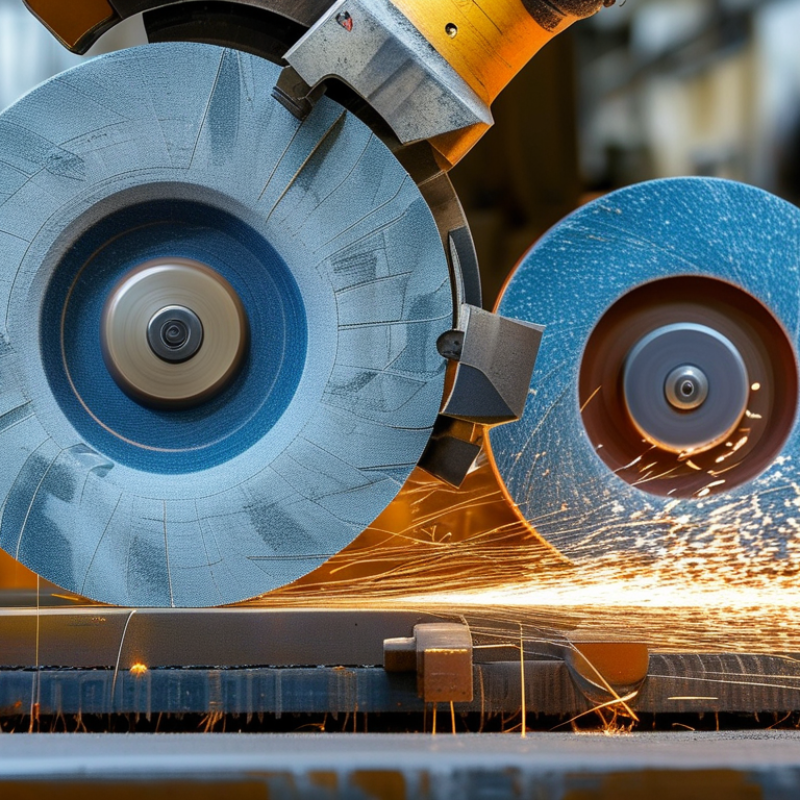
China Top 10 Abrasive Metal Cutting Disc Manufacturers
Abrasive metal cutting discs are thin, reinforced wheels designed to remove metal through controlled abrasion. They contain abrasive grains, bonding materials, and fiberglass reinforcement. The grains fracture during cutting and expose fresh, sharp edges.
These discs commonly cut steel tubing, stainless sheet, rebar, and structural sections. A portable grinder makes a narrow, fast cut. A chop saw offers better alignment for repeated work. The disc must match the machine’s speed rating, diameter, material, and guard. Never force a disc sideways. That creates heat, vibration, and possible breakage.
The abrasive market reflects strong industrial demand. Grand View Research estimated the global abrasives market at about USD 47 billion in 2023, with continued growth through 2030. Its analysis links demand to metal fabrication, transportation equipment, and construction. A 2024 report from MarketsandMarkets also identified bonded abrasives as a major product category. However, market definitions differ between reports. That limitation matters.
In real workshops, performance depends on more than grain hardness. Disc thickness affects speed and control. A thinner disc cuts quickly but may tolerate less misuse. Operators should inspect edges, labels, and reinforcement before use. Keep discs dry and store them flat. Small details matter.
Cut quality is not always perfect. Excessive pressure can discolor stainless steel or leave burrs. The better approach is often slower, steadier, and more deliberate. Personally, I would treat cutting speed as only one measure of quality. Safety, accuracy, and disc life deserve equal attention.
Technical comparison of commonly used abrasive metal cutting disc configurations. Dimensions are shown as diameter × thickness × bore diameter in millimetres.
| No. | Disc Configuration | Typical Size | Abrasive and Grit | Construction | Suitable Metals | Typical Applications | Key Standards and Safety Points |
|---|---|---|---|---|---|---|---|
| 1 | Ultra-thin flat cutting disc | 100 × 1.0 × 16 | Aluminium oxide, typically A60 or A80 | Resinoid-bonded, glass-fibre reinforced, Type 41 flat disc | Mild steel, carbon steel, thin-wall steel tube | Small angle grinders, sheet-metal cutting, light fabrication and quick sectioning | Use only on a compatible grinder. Do not exceed the maximum RPM printed on the disc. Cut straight without twisting. |
| 2 | Thin general-purpose flat disc | 115 × 1.0 × 22.23 | Aluminium oxide, typically A46 to A60 | Reinforced resin bond with one or more fibreglass layers | Carbon steel, structural steel and general iron-based alloys | Portable angle-grinder cutting of bars, profiles, bolts and small plates | The 22.23 mm bore is common for portable angle grinders. The guard must cover the disc correctly. |
| 3 | Stainless-steel cutting disc | 125 × 1.0 × 22.23 | Low-contaminant aluminium oxide, typically A60 or A80 | Resinoid-bonded and reinforced; commonly identified as suitable for stainless steel | Stainless steel, chrome-nickel steel and corrosion-resistant alloys | Cutting stainless tubes, profiles, sheet and small components where iron contamination must be limited | Use a disc specifically rated for stainless steel. Keep it separate from discs used on ordinary carbon steel. |
| 4 | Medium-thickness steel cutting disc | 125 × 1.6 × 22.23 | Aluminium oxide, typically A30 to A46 | Fibreglass-reinforced resin bond, Type 41 flat disc | Mild steel, carbon steel, cast iron and steel sections | General workshop cutting, heavier profiles and repeated fabrication work | A thicker disc offers greater rigidity but removes more material. Apply steady feed pressure and avoid side loading. |
| 5 | Heavy-duty portable cutting disc | 150 × 1.6 × 22.23 | Aluminium oxide, typically A30 to A46 | Reinforced resinoid bond designed for portable cutting equipment | Carbon-steel plate, angle iron, channel, pipe and reinforcing bar | Construction sites, maintenance work and medium-duty metal fabrication | Check that the grinder is rated for the disc diameter. Allow the disc to reach operating speed before contact. |
| 6 | Large portable angle-grinder disc | 180 × 1.6 × 22.23 | Aluminium oxide, typically A30 to A46 | Multiple fibreglass reinforcement layers with resin bond | Structural steel, steel pipe, cast iron and heavy sections | Deep cuts in larger profiles, pipes and fabrication assemblies | Larger discs require careful control because peripheral speed and stored energy are higher. Use the supplied guard and handles. |
| 7 | 230 mm heavy-duty cutting disc | 230 × 1.9 × 22.23 | Aluminium oxide, typically A30 or A36 | Heavy-duty reinforced resin bond, Type 41 flat configuration | Steel plate, large pipe, structural sections and cast iron | Industrial maintenance, construction steelwork and large-section cutting | Use only with a 230 mm-rated grinder and matching maximum operating speed. Never use the disc for grinding. |
| 8 | Stationary cut-off saw disc | 300 × 3.0 × 25.4 | Aluminium oxide, typically A24 to A36 | Rigid, reinforced resinoid disc for stationary or chop-saw equipment | Steel tube, bar stock, angle steel and general ferrous metal | Bench cut-off saws, production cutting and repetitive workshop operations | The machine must provide a secure work rest and a correctly adjusted guard. Clamp the workpiece before cutting. |
| 9 | Industrial chop-saw cutting disc | 350 × 3.0 × 25.4 | Aluminium oxide, typically A24 to A36 | Reinforced resin-bonded disc for stationary high-power cut-off saws | Carbon steel, stainless steel variants, pipe and heavy structural sections | Fabrication lines, steel service centres and repetitive cutting of long stock | Select the disc according to the saw’s rated speed, arbor size and material. Do not force the wheel through the workpiece. |
| 10 | Large stationary cut-off disc | 400 × 3.2 × 25.4 | Aluminium oxide, typically A24 to A36 | Multi-reinforced resinoid disc for approved stationary cut-off machines | Large steel sections, thick-wall pipe, bar and heavy fabrication stock | Heavy industrial cutting where a large cutting depth and rigid machine setup are required | Use only on equipment specifically designed for 400 mm abrasive wheels. Inspect for damage and follow the machine manufacturer’s guard requirements. |
Abrasive metal cutting discs are bonded abrasive tools that use abrasive grains, a resin bond and reinforcing fibre to sever metal by high-speed abrasion. Type 41 refers to a flat cutting-off wheel, while Type 42 generally refers to a depressed-centre cutting-off wheel. Actual maximum operating speed, bore tolerances, reinforcement structure and material compatibility vary by product; always follow the markings on the disc and the instructions for the machine. Relevant safety references include EN 12413 for bonded abrasive products and ANSI B7.1 for the use of abrasive wheels.
A serious evaluation starts with the disc, not the catalog. Check abrasive grain type, resin bond, reinforcement layers, diameter, thickness, and rated speed. Ask for batch records and material traceability. Reliable manufacturers should explain how they control mixing, pressing, curing, and final inspection. Clear answers matter.
Request samples from several production batches. Cut the same steel grade with identical machines and pressure. Record cutting time, disc consumption, burr size, heat marks, vibration, and operator feedback. A clean cut on one plate proves little. Watch the edge after repeated use. Excessive shedding or cracking requires immediate attention. Small details reveal process stability.
Review conformity documents against the standards required in your market, such as EN 12413 or equivalent national requirements. Confirm that test reports match the exact disc specification, not a similar model. Factory audits should examine storage humidity, reinforcement placement, speed testing, and rejected-product control. A video tour helps, but it cannot replace physical verification. No evaluation is perfect. I would still retest after a supplier changes resin, grain source, or production line. Price deserves attention, yet an unusually low quote may hide weaker reinforcement or inconsistent curing. Ask about complaint handling, replacement procedures, and delivery records. A dependable partner provides evidence before requesting trust.
China’s abrasive disc sector combines large-scale production with increasingly specialized engineering. Grand View Research’s 2024 abrasives market report estimated global value at about USD 47 billion in 2023. Asia-Pacific represented the largest regional share, supported by construction, machinery, and automotive production.
The ten leading Chinese manufacturers generally compete through resin formulation, fiberglass reinforcement, and automated balancing. Their profiles often include high-volume factories, private testing laboratories, and export experience across Asia, Europe, and North America.
Many offer discs for stainless steel, carbon steel, cast iron, and general fabrication. Product selection matters. A thin disc can cut quickly, but it may demand stricter handling and machine control.
Independent buyers should examine EN 12413 conformity, ISO 9001 systems, batch traceability, and published cutting tests. The International Organization for Standardization reports that ISO 9001 remains the world’s most widely adopted quality-management standard, with more than one million certificates issued globally. Certification alone proves little. Test conditions must match real workshop use.
Market rankings are not absolute. Public sales data remains limited, and some manufacturers disclose only partial capacity figures. A better profile compares abrasive grain type, disc hardness, shelf life, packaging quality, and measured cutting speed. Factory visits can reveal details that brochures miss, especially dust control, curing consistency, and operator training. Small differences become visible at the workbench. Reliability is earned slowly.
China’s leading abrasive metal cutting disc manufacturers differ most in process control, not appearance. A clean label proves little. Reliable producers control abrasive grain size, resin mixing, fiberglass reinforcement, pressing pressure, and curing temperature. These details influence cutting speed, disc balance, edge stability, and burr formation. The difference is measurable.
Capacity is another important comparison. Larger Chinese factories may operate automated forming lines, multiple curing ovens, and dedicated inspection stations. This supports consistent output for industrial orders. However, high capacity does not automatically mean high quality. Buyers should review monthly production data, lead times, batch traceability, and failure rates. A factory producing millions of discs can still struggle with one unstable resin batch.
Certification adds useful evidence, but it needs careful checking. ISO 9001 indicates a quality management system, while EN 12413 certification relates to safety requirements for bonded abrasive products. Buyers should verify certificate scope, testing records, issuing bodies, and expiration dates. Some suppliers present laboratory reports without linking them to current production. That is a weakness.
In practical audits, request samples from different batches. Test them on the intended metal, grinder, and operating speed. Compare cutting time, vibration, disc wear, and surface finish. Chinese manufacturers can offer strong quality, flexible capacity, and competitive engineering support. Yet supplier claims should never replace independent inspection. No factory is perfect. A transparent producer will explain its limitations, corrective actions, and inspection frequency.
Anonymous benchmark comparison of quality control, production capacity, and certification readiness
The chart uses a normalized 0–100 benchmark based on commonly evaluated sourcing criteria for abrasive cutting disc manufacturers: process consistency and product testing, scalable output and export capability, and documented quality or safety certifications. Manufacturer identities are intentionally omitted; the values are comparative indicators rather than audited company disclosures.
Choosing a Chinese abrasive metal cutting disc manufacturer requires more than comparing prices. According to Grand View Research, the global abrasives market was valued at over USD 45 billion in 2022. Growing demand also increases supplier differences. Request certificates for ISO 9001 and EN 12413 compliance. Check whether certificates match the actual production site, not only a trading office.
Technical evidence matters. Ask for grain type, resin-bond details, disc hardness, reinforcement layers, and maximum operating speed. A reliable manufacturer should provide batch traceability and test reports. During supplier audits, inspect storage conditions, pressing equipment, and final balancing checks. A clean showroom proves little. Request samples from three production batches. Measure cutting time, kerf width, sparks, and disc wear on your own steel grades. Small differences become expensive at scale.
Look beyond the quoted unit price. The 2024 MarketsandMarkets abrasive market report identifies industrial demand and production efficiency as major growth factors. Compare minimum order quantities, tooling charges, packaging strength, and replacement procedures. Factory video calls help, but independent inspections are stronger. I once underestimated packaging damage; the discs passed factory tests but arrived with cracked edges. That mistake changed the evaluation checklist. Do not accept vague claims such as “European quality.” Require measurable limits, signed specifications, and a controlled pilot order before long-term purchasing.