#4 – 20133 102nd Avenue, Langley, B.C. V1M 4B4 Canada

#4 – 20133 102nd Avenue, Langley, B.C. V1M 4B4 Canada
Choosing the right Commercial Display Tv brand involves more than comparing screen size and price. Global buyers need dependable performance, clear documentation, and support that remains available after installation. A bright showroom, a hotel lobby, and a transport terminal create very different operating demands.
This guide examines leading commercial display TV brands through practical buying criteria. These include panel durability, operating hours, brightness consistency, remote management, warranty coverage, and regional service capacity. Published specifications provide a useful starting point. Real deployment evidence matters more. A display may look impressive in a showroom but struggle with heat, dust, or continuous playback.
Details matter.
Brand reputation also deserves careful review. Buyers should check authorized distribution channels, software update policies, energy information, and compatibility with local broadcasting standards. Independent testing and verified customer experiences can reveal weaknesses that marketing materials omit. Warranty terms may vary significantly between countries, even for the same model.
No brand is perfect. Some manufacturers offer stronger panels but limited local support. Others provide flexible software but less consistent color performance. This comparison therefore avoids treating one company as universally superior. It focuses on how each brand serves different commercial environments, budgets, and risk levels. Careful selection can reduce maintenance calls, unexpected downtime, and replacement costs over the display’s working life.
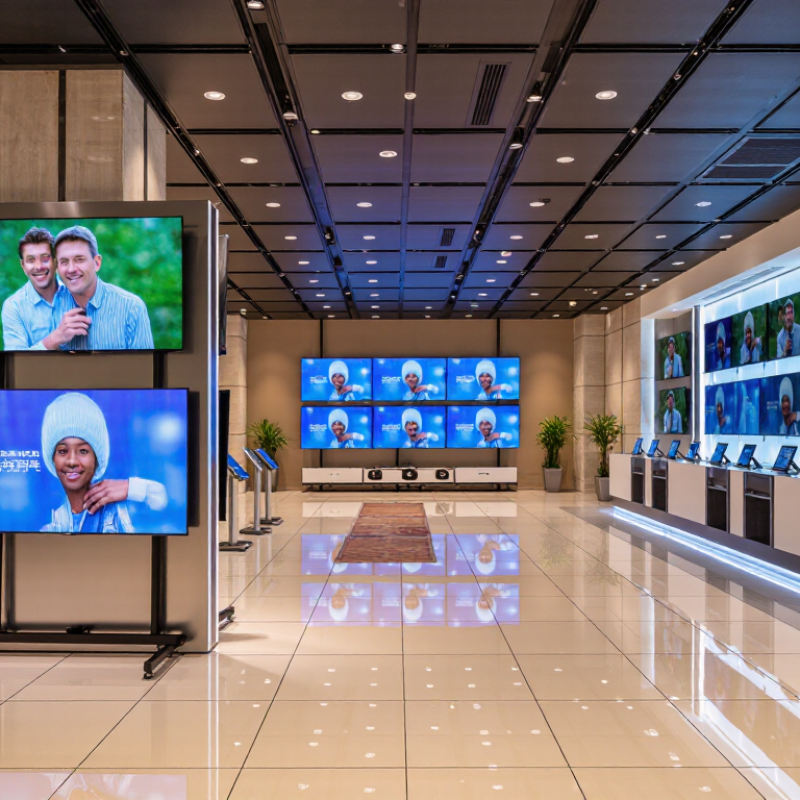
Commercial display TVs are professional screens designed for retail, hospitality, education, transport, and corporate spaces. Unlike household televisions, they support longer operating hours, centralized control, and stricter installation requirements. Typical features include 16/7 or 24/7 operation, commercial warranties, locked settings, portrait orientation, scheduled playback, and remote device monitoring.
The market extends beyond simple entertainment. A hotel lobby may use one screen for arrivals, while a supermarket uses several screens beside changing promotions. The global digital signage market, a closely related segment, was valued at US$26.2 billion in 2023 and may reach US$45.3 billion by 2028, according to MarketsandMarkets. This growth reflects demand for real-time content, audience targeting, and connected displays. Still, digital signage data does not represent commercial TV sales exactly. The categories overlap, but they are not identical.
Buyers should evaluate brightness, viewing distance, ventilation, mounting strength, software compatibility, and service response. A bright panel can improve readability near windows, but it may increase power use. Remote management reduces site visits, although network failures can interrupt content. Independent testing and written warranty terms matter. From practical deployment experience, the cheapest screen is rarely the lowest-cost option after installation, maintenance, and replacement time. Some specifications also sound impressive but need verification in the intended environment.
| Data Dimension | Typical Commercial Display TV Information | Why It Matters to Global Buyers | Common Application Scope |
|---|---|---|---|
| Product definition | A professional large-format display designed for business, public, hospitality, retail, education, and institutional environments. | Commercial models are generally built for longer operating schedules, centralized management, and more demanding installation conditions than household televisions. | Retail stores, hotels, restaurants, offices, schools, healthcare facilities, transportation hubs, and public venues. |
| Display technology | Most products use LCD panels with LED backlighting. Professional LED, direct-view LED, and fine-pitch LED systems are used for larger or more specialized installations. | The technology affects image quality, viewing distance, installation flexibility, energy consumption, and total project cost. | LCD for general signage and indoor viewing; direct-view LED for large-format, high-impact, or seamless display walls. |
| Screen size range | Common commercial LCD sizes range from approximately 32 to 98 inches, while modular LED displays can be configured at much larger dimensions. | Size selection depends on room dimensions, audience distance, mounting method, content type, and required visibility. | Small information screens, meeting rooms, retail signage, hotel displays, lecture halls, and large public advertising surfaces. |
| Resolution | Full HD remains suitable for many basic signage applications. 4K UHD is widely selected for detailed promotional content, presentations, dashboards, and close-viewing areas. | Higher resolution improves text clarity and image detail, particularly when viewers are close to the screen. | Corporate presentations, product demonstrations, digital menus, control rooms, design reviews, and high-detail advertising. |
| Brightness | Indoor commercial displays commonly offer approximately 350–700 cd/m². Higher-brightness models are available for brightly lit areas and semi-outdoor applications. | Brightness should be matched to ambient light. Excessive brightness may increase power use, while insufficient brightness can reduce readability. | Indoor signage, shop windows, transit areas, atriums, event spaces, and covered outdoor locations. |
| Operating schedule | Professional displays are commonly specified for extended daily operation, such as 16/7 or 24/7, depending on the model and installation requirements. | The rated duty cycle helps buyers select equipment that can support continuous business operations and reduce unplanned downtime. | Airports, shopping centers, control rooms, security monitoring, hospitality, broadcast support, and public information systems. |
| Orientation and installation | Depending on the model, displays may support landscape or portrait orientation, wall mounting, ceiling mounting, floor stands, kiosks, or video-wall configurations. | Installation compatibility affects project design, viewing angle, ventilation, structural loading, and maintenance access. | Digital signage, wayfinding, menu boards, meeting rooms, reception areas, retail columns, and video walls. |
| Connectivity | Typical interfaces include HDMI, DisplayPort, USB, Ethernet, RS-232, Wi-Fi, and sometimes SDI or professional control interfaces. | Connectivity determines compatibility with media players, computers, cameras, control systems, room systems, and content networks. | Video conferencing, signage networks, classrooms, command centers, retail content systems, and event production. |
| Content management | Many commercial displays support USB playback, embedded media players, network-based content management, scheduling, remote monitoring, and device control. | Centralized control simplifies updates across multiple locations and helps reduce manual maintenance costs. | Multi-site retail, hotel chains, franchise networks, campuses, hospitals, transport facilities, and corporate offices. |
| Durability and protection | Relevant specifications may include reinforced housing, thermal management, dust protection, anti-glare treatment, commercial-grade components, and optional impact or weather protection. | Protection requirements vary by location and influence service life, maintenance frequency, and installation cost. | Busy public areas, retail environments, industrial sites, covered outdoor spaces, and high-traffic facilities. |
| Energy and environmental factors | Power consumption varies with screen size, brightness, operating hours, display technology, and power-management settings. Buyers may also review applicable energy and environmental compliance requirements. | Energy performance influences operating expenditure and may support sustainability targets or procurement policies. | Large signage networks, public-sector procurement, offices, educational institutions, and environmentally focused projects. |
| Regional compliance | Global projects may require conformity with local electrical safety, electromagnetic compatibility, wireless, energy, recycling, and product-labeling regulations. | Compliance documentation helps prevent customs delays, installation issues, procurement rejection, and regulatory penalties. | International distribution, public tenders, cross-border projects, commercial real estate, and multi-country deployments. |
| Market scope | The commercial display TV market covers professional signage, corporate collaboration, hospitality, retail, education, healthcare, transportation, public information, entertainment, and control-room applications. | Market demand is shaped by digital transformation, content personalization, remote device management, replacement cycles, venue modernization, and large-scale infrastructure projects. | Indoor and semi-outdoor commercial environments across regional, national, and international buyer markets. |
Note: Specifications are representative industry ranges and should be verified against the technical documentation, regulatory requirements, and installation conditions of the selected product.
Choosing a commercial display TV brand requires more than comparing screen size and price. Global buyers should examine brightness, contrast, viewing angles, and expected operating hours. A screen placed near a shop window may need stronger brightness than one used in a shaded conference room. Check whether the panel maintains readable text after several hours of continuous use.
Reliability depends on evidence. Review technical datasheets, independent test results, warranty terms, and regional service coverage. Confirm available ports, network controls, content-management compatibility, and automatic restart settings. Thermal performance also matters in enclosed cabinets. I once focused too heavily on image quality and overlooked service response time. That mistake delayed a replacement and increased installation costs. A higher specification is not always the better investment.
Tips: Request a sample unit before ordering in volume. Test it under real lighting, with local power conditions, and through your intended content system. Ask for documented repair procedures, spare-part availability, and firmware support. Check energy ratings and applicable regional certifications. Keep written records of every promise. Clear documentation builds trust, although it can still fail to reveal long-term weaknesses.
Commercial display television procurement is becoming a regional decision, not a simple brand comparison. Buyers in airports, hotels, hospitals, and retail stores need different operating profiles. According to MarketsandMarkets’ Digital Signage Market report, the sector was valued at approximately US$27.1 billion in 2024. It is projected to reach about US$40.7 billion by 2029. That growth reflects demand for networked screens, remote monitoring, and measurable audience engagement.
Global buyers should compare commercial display TV brands through local performance evidence. In bright retail windows, brightness above 700 nits can improve readability, but it may increase power consumption. Hospitality projects often prioritize slim installation, centralized control, and long warranty coverage. Public facilities need stable operation, accessible service centers, and documented safety certifications. DisplayPort, HDMI, Wi-Fi, and content-management compatibility also deserve testing before purchase. Small details matter.
AVIXA’s 2024 Industry Outlook and Trends Analysis identifies digital signage and content distribution as important professional AV investment areas. Yet, a specification sheet cannot predict every installation problem. A screen tested in a quiet office may behave differently in a dusty transport terminal. No scorecard is perfect. Buyers should request sample units, measure heat after eight hours, and verify repair times in each target country. Price remains visible, but downtime often costs more.
Commercial display selection should begin with business use, not screen size. Retail stores often need high brightness, wide viewing angles, and continuous operation. Meeting rooms usually value low power consumption, wireless control, and clear text. For public transport, temperature tolerance and remote monitoring matter more. AVIXA’s 2024 Industry Outlook places the professional audiovisual market above US$300 billion, reflecting strong demand for managed display systems.
Technology changes the buying equation. LCD remains practical for large networks because replacement panels are widely available and costs are predictable. Direct-view LED supports seamless walls, strong contrast, and large-format viewing, but installation quality affects reliability. OLED offers excellent black levels, although static content can increase image-retention concerns. According to Omdia’s 2024 Professional Displays and Signage Market Tracker, LED adoption continues expanding in premium commercial applications. The report also indicates uneven regional demand, so local service capacity deserves equal attention.
Reliability requires evidence. Ask for rated operating hours, thermal limits, panel warranty terms, spare-part availability, and documented burn-in testing. Marketing claims are not enough. A 24/7 display needs stronger cooling than a conference-room screen. Independent certifications can help compare energy performance, while the 2024 Global E-waste Monitor recorded 62 million tonnes of electronic waste worldwide in 2022. Longer service life therefore has financial and environmental value. Buyers should still challenge every specification, because published performance may change under heat, dust, or continuous static images.
Top Commercial Display TV Brands for Global Buyers
Global buyers should evaluate commercial display suppliers beyond image quality and screen size. Reliable support often determines whether a display remains useful after installation. Ask about response times, local technicians, spare parts, firmware updates, and warranty coverage. A clear service agreement is more valuable than vague promises. In my experience, delayed replacement panels can disrupt a hotel lobby, retail wall, or transport terminal for weeks.
Compliance also varies by destination. Confirm voltage ranges, plug standards, energy requirements, recycling obligations, and required safety certifications before placing an order. Check whether the tuner, wireless functions, and language settings match the target market. Documentation should be available in a usable format, not hidden in a sales folder. One assumption deserves challenge: international shipping does not guarantee regional compliance.
Tips: Build a landed-cost sheet before comparing quotations. Include freight, insurance, duties, installation, mounting hardware, software, energy use, and disposal. Request sample units for brightness, viewing angles, heat, and menu testing. Record every promise in the purchase agreement. A low price can still be expensive. I have seen buyers overlook replacement logistics and pay more during the first service call. That mistake is avoidable, although no forecast is perfect. Review projected usage hours and failure risks with an independent technician when possible.
Global Buying Considerations: Support, Compliance, and Total Cost
This 100-point planning model shows how global buyers can prioritize commercial display purchases: total cost of ownership receives the highest weighting, followed by compliance, technical support, reliability, and deployment flexibility. The values are planning weights rather than rankings of individual companies or brands.