#4 – 20133 102nd Avenue, Langley, B.C. V1M 4B4 Canada

#4 – 20133 102nd Avenue, Langley, B.C. V1M 4B4 Canada
Choosing among the 2026 best Barite Drywall Radiation Shielding suppliers requires more than comparing prices. A reliable supplier should provide consistent barite density, clear panel thickness, verified lead-equivalent data, and complete batch documentation. Product performance depends on the radiation source, workload, room geometry, and installation quality. A heavy panel cannot compensate for an incomplete design.
Dr. Michael G. Stabin, a recognized radiation-protection specialist, states, “Radiation protection is about managing risk through careful design and verification.” This principle applies directly to Barite Drywall Radiation Shielding. Buyers should request laboratory test reports, fire-resistance classifications, moisture guidance, fastening details, and project references. Site measurements also matter. Small gaps around doors, service penetrations, electrical boxes, and joints can weaken an otherwise strong barrier.
The best suppliers usually work with medical physicists, architects, and qualified installers. They do not promise universal protection from one standard panel. That claim deserves caution. A dependable company explains limitations openly and supports calculations before delivery. It should also describe how panels are stored, cut, sealed, and inspected onsite.
This guide examines suppliers through practical evidence, technical support, manufacturing consistency, and customer experience. Some supplier information may change during 2026. It is wise to verify current certifications directly. The market is not perfectly transparent. Careful comparison remains necessary. A lower quotation may hide installation challenges, inconsistent density, or missing documentation. Good shielding begins with measured requirements, not attractive marketing.
What Is Barite Drywall Radiation Shielding?
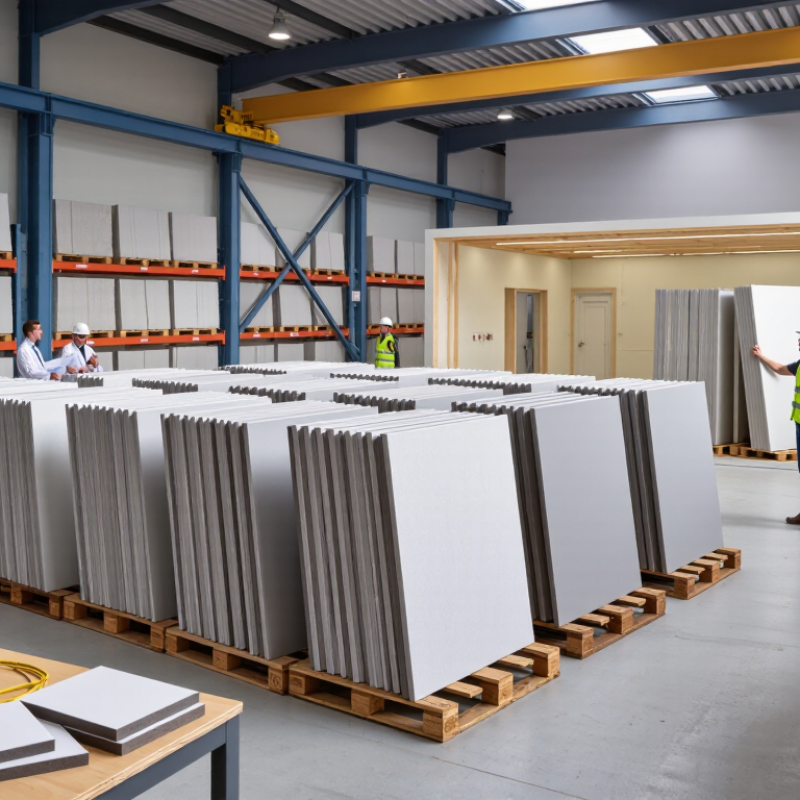
Barite drywall is a radiation-shielding panel made with barite, a dense barium sulfate mineral. Its specific gravity usually ranges from 4.2 to 4.5, according to the U.S. Geological Survey Mineral Commodity Summaries. That density helps absorb scattered X-rays in diagnostic rooms, dental clinics, and imaging suites.
The panel looks like ordinary drywall, but it feels noticeably heavier. Installers often cut it around electrical boxes, doors, and service openings. Those small gaps can weaken the shielding path. A careless joint may matter more than a perfect panel.
NCRP Report 147 states that shielding design should consider workload, radiation energy, room occupancy, and distance. It does not support one universal thickness. The report commonly uses weekly design goals of 0.1 mSv for controlled areas and 0.02 mSv for uncontrolled areas. IAEA Safety Standards Series SSG-46 also stresses facility-specific calculations and qualified assessment. Barite drywall should therefore be selected after reviewing the equipment’s kVp, operating schedule, wall layout, and adjacent spaces. Its lead-equivalent rating can change with beam energy and testing conditions. This detail is easy to overlook.
In practical work, a supplier should provide density data, thickness tolerances, fire performance, installation guidance, and independent test documentation. Product labels alone are insufficient. A shielding physicist should verify the final design before construction and after installation. That extra check may feel slow, but radiation protection should not depend on guesswork.
| Evaluation Dimension | Technical Data or Typical Range | Why It Matters | Supplier Documentation to Request | Selection Guidance |
|---|---|---|---|---|
| Shielding Material | Barite drywall uses gypsum-based panels containing barium sulfate (BaSO4), a high-density mineral used to attenuate diagnostic X-rays. | Higher material density generally allows more attenuation per unit thickness, although performance depends on photon energy, thickness, installation, and joints. | Product composition statement, safety data sheet, technical data sheet, and independent test information. | Prefer suppliers that clearly disclose the shielding material, panel construction, and intended radiation-energy range. |
| Panel Density | Radiation-shielding gypsum panels are substantially denser than standard gypsum board; the actual value must be confirmed from the product technical data sheet. | Density affects the calculated attenuation and the structural load imposed on walls, ceilings, and framing. | Declared dry density, areal weight, dimensional tolerances, and test method. | Compare products by both density and areal mass rather than by thickness alone. |
| Panel Thickness | Common gypsum-board thickness categories include approximately 12.7 mm and 15.9 mm, while shielding systems may use thicker or multilayer assemblies. | Required thickness depends on workload, tube voltage, occupancy, distance, use factor, and the required design goal. | Available thicknesses, multilayer installation details, edge-treatment instructions, and approved accessories. | Do not select thickness from a generic table without a radiation-shielding assessment. |
| Lead-Equivalent Performance | Lead equivalence is not a universal value for every panel. It varies with X-ray energy, test geometry, panel thickness, and the specified measurement method. | A single lead-equivalent number can be misleading if the test energy does not match the actual medical or industrial application. | Independent attenuation report identifying tube voltage or radiation spectrum, geometry, thickness, and acceptance criteria. | Use project-specific calculations and verified test data instead of relying only on marketing claims. |
| Radiation Design Standard | Shielding design is commonly based on recognized guidance such as NCRP Report No. 147 for medical X-ray imaging facilities, where applicable. | Standards help define workload, occupancy, use, distance, controlled areas, and uncontrolled areas. | Design calculation package prepared or reviewed by a qualified radiation-shielding physicist. | The supplier should support the design professional but should not replace the project radiation consultant. |
| Joint and Penetration Control | Shielding continuity must be maintained at panel joints, corners, door frames, service penetrations, electrical boxes, ducts, and ceiling interfaces. | Unprotected gaps can reduce the effectiveness of an otherwise adequate wall assembly. | Joint layout, screw pattern, corner details, penetration details, sealant specifications, and installation drawings. | Choose a complete system with tested or engineered details, not panels supplied without installation guidance. |
| Mechanical Loading | Barite-containing panels can weigh considerably more per square metre than standard gypsum board. | Heavy assemblies may require enhanced studs, closer framing, stronger tracks, additional fixings, or floor-load review. | Panel mass per unit area, recommended framing, fastener schedule, lifting guidance, and structural limitations. | Confirm the wall, ceiling, and floor structure before purchase and installation. |
| Fire and Building Performance | Fire resistance, acoustic performance, moisture resistance, and impact resistance depend on the complete tested assembly rather than the shielding mineral alone. | Changing board type, fastener spacing, framing, or joint treatment can invalidate the performance of a listed assembly. | Fire-test classification, acoustic data, moisture limitations, installation conditions, and applicable conformity documents. | Match the shielding wall system to local building-code requirements and the room environment. |
| Dimensional Quality | Important quality indicators include consistent thickness, flatness, edge integrity, moisture content, and controlled panel dimensions. | Dimensional variation can create gaps, uneven joints, installation delays, and inconsistent shielding continuity. | Quality-control plan, batch inspection records, dimensional tolerances, and packaging specifications. | Request representative samples and inspect edges, faces, and packaging before approving a large order. |
| Mineral Consistency | Barite is naturally occurring barium sulfate. Its mineral purity, particle distribution, and moisture condition can vary by source and production batch. | Material variation can affect density, workability, panel weight, and reproducibility of shielding performance. | Batch traceability, mineral composition information, density records, and production consistency data. | Prefer suppliers with documented batch control and a defined process for handling nonconforming material. |
| Indoor-Air and Handling Safety | Barium sulfate is highly insoluble, but cutting and sanding gypsum products can generate respirable dust. | Worker exposure is primarily managed through dust control, ventilation, suitable respiratory protection, and safe handling procedures. | Safety data sheet, occupational handling instructions, dust-control recommendations, and waste-disposal guidance. | Evaluate the supplier’s installation safety documentation as well as the finished product. |
| Installation Support | Successful installation requires compatible screws, joint treatment, cutting methods, lifting procedures, and continuity details. | Improper cutting, fastening, or joint treatment can create weak points and increase project cost. | Installation manual, method statement, training availability, technical support contacts, and warranty conditions. | For complex imaging rooms, select a supplier able to provide project-specific technical support. |
| Quality Verification | Useful verification includes factory quality records, independent attenuation testing, dimensional inspection, and delivery-batch traceability. | Third-party or independently reviewed evidence provides stronger assurance than an unverified performance claim. | Certificate of analysis, test reports, inspection records, calibration information, and traceability documents. | Check that documents identify the exact product configuration being quoted. |
| Supply Capability | Key commercial factors include production capacity, standard lead time, minimum order quantity, packaging, export capability, and replacement stock. | Shielding projects are schedule-sensitive and may require consistent quantities across multiple rooms or phases. | Capacity statement, lead-time estimate, packaging specification, logistics plan, and production continuity information. | Compare total delivered cost and schedule risk, not only the unit price. |
| Best-Fit Supplier Profile | A strong supplier profile combines verified attenuation data, consistent density, complete installation details, traceable quality control, and responsive technical support. | Radiation shielding is a system-performance issue; the lowest-priced panel may not provide the lowest installed or compliance risk. | Complete technical submittal, project references without undisclosed claims, sample approval process, warranty, and after-sales support plan. | Shortlist suppliers that can document performance for the intended room design and local regulatory requirements. |
How Barite Drywall Protects Against Radiation
Barite drywall uses a dense core containing barium sulfate, a mineral with strong radiation-absorbing properties. For diagnostic X-rays, this density reduces the radiation passing through walls, ceilings, and protective partitions. The material is not radioactive. Its shielding effect comes from mass, thickness, and careful placement. In practical installation work, panels can feel unusually heavy and require secure framing. That physical weight is part of their protective function. Barite drywall is often selected for imaging rooms, dental clinics, laboratories, and other controlled areas where scattered radiation may occur.
Reliable shielding begins with a room assessment, not a product name. A qualified radiation physicist should calculate the required thickness for the equipment, workload, distance, and nearby occupied spaces. Installers must stagger joints and seal gaps around doors, outlets, pipes, and ventilation openings. A small weakness can reduce confidence in an otherwise strong wall. That detail is easy to underestimate.
Testing data should be reviewed alongside local building and radiation-safety requirements. Real site conditions may differ from laboratory results. Moisture, damaged edges, poor fastening, or unplanned penetrations can affect performance. Barite drywall also does not replace equipment shielding, safe working procedures, or controlled access. Its effectiveness depends on the complete assembly. That is the part suppliers sometimes explain too briefly.
2026 Best Barite Drywall Radiation Shielding Suppliers?
Evaluating barite drywall suppliers starts with verified performance, not catalogue thickness. NCRP Report No. 147 states that shielding design depends on workload, distance, occupancy, and use factors. Therefore, a fixed “one-size-fits-all” panel claim deserves caution. Ask suppliers for tested density, thickness tolerance, compressive strength, and radiation attenuation results. Independent laboratory reports should identify the beam energy and test method clearly. Vague certificates are not enough.
Material consistency matters on a real installation. A panel with uneven barite distribution can create weak zones around seams, outlets, and service penetrations. Request batch records, sampling procedures, and documented quality controls. IAEA Safety Reports Series No. 47 emphasizes qualified shielding assessment and on-site verification. Suppliers should provide technical drawings, joint details, installation guidance, and support for a radiation physicist’s review. Delivery data also matters, including breakage rates and replacement procedures.
Price comparisons can mislead. A lower-cost panel may require thicker construction, stronger framing, or more complicated handling. Check declared density against measured values, because small variations affect design confidence. Ask for recent project references, but verify them independently. That step is often skipped. UNSCEAR’s 2020/2021 scientific assessments show that medical imaging remains a major source of population exposure from artificial radiation, making traceable shielding decisions important. Still, supplier documents cannot replace a project-specific calculation. Even experienced buyers should question assumptions, especially when room layouts change late.
Leading barite drywall radiation shielding suppliers in 2026 are judged by more than product thickness. Reliable suppliers provide verified barite density, clear technical data, and installation guidance for medical imaging rooms. Their panels should arrive with consistent dimensions, sealed edges, and documented quality checks. Small defects matter.
Experienced suppliers also support project-specific shielding calculations. They review room layouts, equipment energy levels, wall joints, ceilings, doors, and service penetrations. A serious technical team coordinates with qualified radiation shielding professionals before production. It should explain assumptions instead of promising one universal solution. That honesty is important.
Field inspections often find gaps around electrical boxes and pipe openings. Leading suppliers offer compatible accessories, joint details, and repair recommendations. They may provide sample panels for density testing and help contractors reduce dust during cutting. However, delivery speed can become a weakness in busy markets. Buyers should confirm batch consistency, storage conditions, replacement procedures, and regional compliance documents. Not every supplier handles these details well. A lower price may hide installation delays or extra reinforcement work. In 2026, dependable sourcing means comparing evidence, communication, and technical support, not just catalog specifications.
Selecting a suitable barite drywall supplier requires more than comparing prices. In practice, a polished brochure proves little. Ask for technical data showing panel thickness, density, barite content, and shielding performance. Confirm whether results come from independent laboratory testing. Request current batch records, safety documentation, installation instructions, and material traceability.
A reliable supplier should understand the room’s radiation source and design conditions. They should request equipment details, workload, wall dimensions, and adjacent occupancy. A supplier making instant recommendations without these details deserves caution.
The final shielding design should be reviewed by a qualified radiation protection professional. The supplier provides materials, not a substitute for professional assessment.
Small gaps matter. Pay attention to joints, corners, outlets, doors, and penetrations.
Request a physical sample before placing a large order. Check its edges, surface flatness, labeling, and stated weight. Compare the sample with the delivered batch. Keep photographs and delivery records.
Contact previous commercial customers, but verify their project similarities. A hospital room and a dental imaging room may need different solutions.
Certifications can help, yet they do not guarantee installation quality.
One overlooked weakness is after-sales support. Ask how damaged panels, missing documents, or inconsistent measurements are handled. No supplier is perfect. Their response to an uncomfortable question often reveals more than their sales presentation.